- News & Insights
- Customer Experience
- How to Start Creating AI-Integrated Customer Experience (CX)
How to Start Creating AI-Integrated Customer Experience (CX)

Customer expectations have shifted dramatically. Today’s consumers expect instant, personalised, 24/7 engagement across every channel. Traditional customer experience (CX) operating models built around reactive ticketing, rigid phone trees, and siloed agent workflows are struggling to keep pace with demand.
Artificial Intelligence (AI) has moved from an experimental luxury to an essential operational engine. When strategically integrated into your CX stack, AI transforms customer interactions from isolated service calls into fluid, anticipatory relationship builders.
However, rolling out AI in CX isn’t just about launching a generic chatbot or turning on automated email replies. Successful implementation requires a clear strategy: aligning data infrastructure, empowering human agents, mitigating automation risks, and measuring real business impact.
In this comprehensive guide, we walk you through how to start building an AI-integrated CX ecosystem from the ground up, combining automated intelligence with human-centred service.
Why AI Integration is Imperative
Hard data backs the business case for AI in customer experience. Modern enterprises face a dual pressure: rising operational costs and escalating customer expectations for rapid resolution.
According to global benchmark studies across enterprise customer service organisations:
| Key CX Metric | Traditional Operations | AI-Integrated Operations | Impact & Benchmark Source |
| First Contact Resolution (FCR) | 65% – 70% average | 82% – 90% with AI co-pilots | +15% to 20% improvement Salesforce State of Service |
| Average Handle Time (AHT) | 6 – 9 minutes per ticket | 3.5 – 5 minutes per ticket | 30% – 45% reduction McKinsey & Company |
| Self-Service Containment | 15% – 25% (Basic FAQs) | 55% – 70% Conversational AI | 2.5x to 3x increase Gartner CX Research |
| Cost per Interaction | $6.00 – $12.00 (Human Agent) | $0.25 – $1.50 AI Self-Service | Up to 85% cost reduction Harvard Business Review |
| Agent Retention Rate | 60% – 68% annual retention | 80% – 88% annual retention | 20%+ reduction in burnout Liveware Internal Research |
Integrating AI into CX isn’t merely about cutting costs; it’s about freeing up human capital to handle high-empathy, complex inquiries while AI manages repetitive operational overhead.
Step 1: Assess Your CX Maturity and Map High-Impact Use Cases
Before evaluating AI platforms or writing code, evaluate where your enterprise sits on the customer experience journey. Attempting to deploy autonomous AI agents atop fragmented customer data or legacy systems often results in disjointed user experiences.
At Liveware, we encourage organisations to evaluate their positioning on The CX Maturity Curve to establish a reliable baseline before launching advanced automation initiatives.

Identifying High-Impact AI Entry Points
Start by conducting a customer journey audit. Use data to pinpoint where friction occurs, where response times spike, and where agents spend repetitive manual effort. As detailed in our guide on Identifying CX Gaps, pinpointing operational bottlenecks is the vital first step toward implementing target solutions.
Here are four high-value AI entry points for enterprise teams:
- Intelligent Routing & Intent Recognition: Natural Language Processing (NLP) models instantly analyse incoming support requests, parse sentiment, and route customers to the correct tier or specialised agent.
- AI Agent Assist (Co-Pilots): Real-time suggested replies, internal knowledge base retrieval, and automated case summarisation reduce administrative burden on support reps.
- Conversational Self-Service: Generative AI-powered bots handle transactional interactions—such as order tracking, subscription updates, or account verification—in natural, conversational dialogue.
- Proactive & Predictive Engagement: Machine learning models analyse historical customer behavioural data to predict churn risk, suggest proactive interventions, or recommend tailored next-best actions.
Step 2: Design Human+AI Workflows
A common mistake enterprise leaders make when deploying AI in CX is over-automating customer touchpoints. Placing rigid, unhelpful bots in front of frustrated users creates friction and damages brand loyalty.
This challenge is known as The Self-Service Paradox: self-service technology is intended to empower customers, but poorly designed, forced automation frustrates users and increases escalation rates.
The “Human-in-the-Loop” Framework
To create a seamless CX experience, design workflows where AI and human teams work in tandem rather than in isolation:
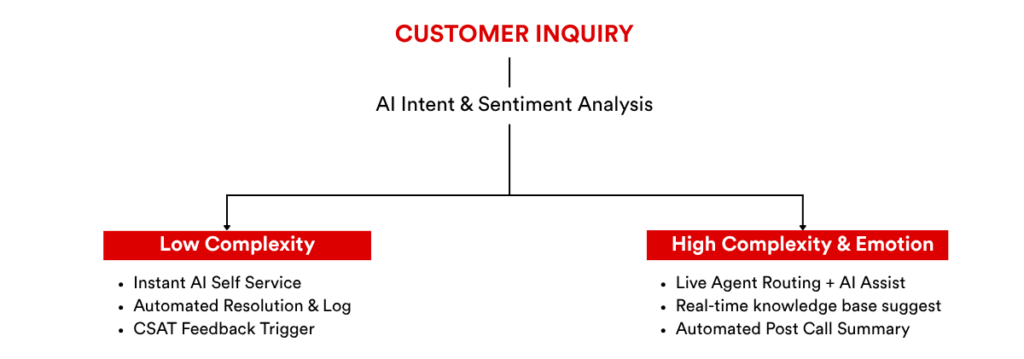
Clear Escalate Pathways: Always provide an intuitive, friction-free mechanism for customers to connect with a human agent when an automated flow cannot resolve their issue.
Contextual Handoffs: When an AI transfers a customer to a human agent, the full conversation transcript, intent analysis, and customer profile must transfer instantly. Customers should never have to repeat themselves.
Support Agent Burnout Prevention: Deploying AI co-pilots handles routine administrative tasks, allowing team members to focus on meaningful customer problem-solving. This approach aligns directly with strategies for Solving Customer Support Spikes without Agent Burnout.
Step 3: Build a Unified Data Foundation & Cloud Architecture
AI is only as intelligent as the data feeding it. Siloed customer records, outdated CRM entries, and isolated knowledge bases will lead to inaccurate AI outputs or hallucinated responses.
To power contextual AI interactions, your technology infrastructure must support unified, real-time data streaming across all customer touchpoints.
Modern AI-CX Data Architecture
| Layer | Component | Enterprise Function |
| Ingestion Layer | Omnichannel API Connectors | Captures interactions across Web Chat, Mobile App, Voice, Email, Social, and Messaging APIs. |
| Data Layer | Customer Data Platform (CDP) | Consolidates transactional history, behavioural logs, and profile attributes into a single customer view. |
| Knowledge Layer | Vector Database & RAG Architecture | Indexes knowledge bases, policy documents, and product manuals using Retrieval-Augmented Generation (RAG) for accurate retrieval. |
| Intelligence Layer | Large Language Models (LLMs) & Predictive ML | Processes intent, generates contextually accurate responses, and scores customer sentiment in real time. |
| Execution Layer | Agent Workspace & Automation Engine | Triggers API workflows (e.g., refund processing, booking updates) and feeds insights directly to human agent dashboards. |
Transitioning to an architecture capable of supporting continuous AI data flows requires scalable infrastructure. Implementing Cloud-Native Engineering ensures your CX stack has the resilience, speed, and API connectivity needed to run real-time AI workloads at scale.
Furthermore, applying Predictive Analytics for Growth allows organisations to transition from reactive problem-solving to anticipating customer needs before they manifest as support tickets.
Step 4: Compare AI Integration Approaches
When building your AI-integrated CX ecosystem, selecting the right deployment model depends on your internal engineering resources, security constraints, and operational complexity.
| Deployment Model | Primary Use Case | Time to Value | Customization & Control | Operational Risk |
| Out-of-the-Box SaaS AI | Standard helpdesk enhancement & FAQ automation | Fast (2 – 6 weeks) | Low – Medium | Low (Vendor managed) |
| Hybrid RAG Integration | Context-aware support using internal knowledge bases & CRMs | Moderate (2 – 4 months) | High | Low – Medium (Grounded source data) |
| Custom Fine-Tuned LLM Pipeline | Highly specialised industries (Healthcare, Banking, Legal) | Extended (6+ months) | Maximum | Requires strict governance & validation |
| Strategic Ecosystem Partnerships | Co-managed digital transformation with specialist integrators | Accelerated (1 – 3 months) | High (Tailored to enterprise goals) | Low (Expert oversight) |
Step 5: A Step-by-Step Implementation Roadmap
Implementing AI across your CX strategy requires a structured execution roadmap to minimise operational disruption and drive team adoption.
1. Establish Governance & Clear Data Boundaries: Prerequisite for compliance and data privacy.
Before connecting AI models to customer records, define strict data governance rules. Ensure PII (Personally Identifiable Information) masking is configured, set role-based access controls, and establish clear guidelines on how customer interaction data will be stored and sanitised.
2. Cleanse and Unify Knowledge Sources: Quality inputs ensure reliable outputs.
Audit your existing internal knowledge bases, policy PDFs, and help centre articles. Standardise documentation, remove outdated procedures, and format content to support Retrieval-Augmented Generation (RAG) indexing.
3. Deploy AI Assistance to Human Agents First (Pilot Phase): Internal rollout before customer-facing launch.
Roll out AI co-pilots internally to your support tier first. Allowing agents to test AI-suggested responses, auto-summarisation, and knowledge retrieval provides a controlled environment to validate model accuracy while boosting team productivity.
4. Launch Phased Customer-Facing Conversational AI: Start with high-volume, low-complexity intents.
Introduce automated conversational flows for targeted, transactional use cases (e.g., order tracking, reset requests, basic account updates). Monitor containment, fallback rates, and user feedback continuously.
5. Iterate, Fine-Tune, and Expand Scope: Continuous performance optimisation.
Review edge cases where the AI failed to resolve queries or triggered agent escalations. Refine prompt templates, update knowledge embeddings, and gradually expand the range of automated customer journeys.
Measuring Business Value: Key KPIs and ROI
To justify ongoing investment in AI-driven CX, leadership must track operational efficiencies alongside financial outcomes and customer sentiment.
Demonstrating The Business Value of CX requires connecting AI performance metrics directly to business profitability:

Essential Metrics Framework
- Customer Satisfaction (CSAT) & Net Promoter Score (NPS): Measure post-interaction satisfaction, specifically comparing AI-only, hybrid, and human-only interactions to ensure quality remains consistent.
- First Contact Resolution Rate (FCR): Track the percentage of queries fully resolved at the initial touchpoint without secondary follow-ups.
- Deflection / Containment Rate: The percentage of incoming inquiries successfully resolved through automated self-service without requiring human agent intervention.
- Time to Competency (TTC) for Agents: The time required to onboard new support team members when supported by AI co-pilots and real-time knowledge guidance.
- Cost Per Interaction (CPI): Total monthly customer service operating costs divided by total resolved interaction volume.
Transform Your Customer Experience with Liveware
Integrating AI into customer experience requires balancing advanced technology with human-centred service design. From audit to implementation, building an AI-powered CX model demands software engineering expertise, data integration capability, and deep operational domain knowledge.
At Liveware, we partner with global enterprises to design, build, and scale modern, high-performing CX organisations. Whether you need cloud-native engineering, data platform integration, agent co-pilot development, or strategic CX consulting, our team helps transform customer interactions into measurable competitive advantage.
Ready to Accelerate Your AI CX Journey?
Let’s turn your CX strategy into an intelligent, scalable growth driver.
Contact us to speak with our CX and technology specialists for a personalised assessment of your customer experience ecosystem.